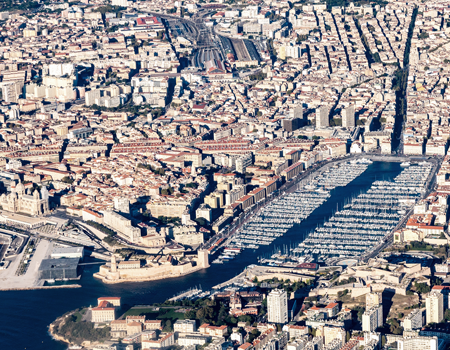
Marseille, one of France’s oldest and most historic port cities, is rapidly expanding its citywide surveillance network to strengthen public safety and support law enforcement. As part of this “safe city” initiative, the city is deploying 250 to 300 new high-definition cameras, extending coverage across public spaces, transit hubs, and other hard-to-reach locations.
But delivering high-bandwidth connectivity across such an intricate, centuries-old urban layout brings massive deployment hurdles. With its dense neighborhoods, maze-like corridors, and heavily protected historic landmarks, traditional fiber cannot reach every location without significant disruption.
THE CHALLENGES
Expand Surveillance Coverage | Bypass "Un-diggable" Terrain | Protect Historic Aesthetics | Maintain Total Sovereignty
Marseille’s vision for a safer, connected city demanded high-capacity connectivity everywhere, including locations where traditional fiber deployment would be slow, disruptive, or impossible.
-
High growing connectivity demand: Modern smart city networks must support applications with very different bandwidth, latency, reliability, and coverage requirements. Video surveillance is one of the most bandwidth-intensive municipal applications because high-definition video must move continuously from distributed camera sites to monitoring and response systems.
-
Historic urban constraints: Narrow streets, dense infrastructure, and protected areas limited where the city could dig new fiber routes without disrupting major transportation arteries, local businesses, public spaces or incurring civil engineering costs.
-
Impassable topography and hard-to-reach terrain: Beyond the ancient city core, steep hills, coastal zones, and areas with solid bedrock created practical barriers for trenching and civil engineering work.
-
Regulatory and preservation restrictions: Large portions of Marseille are strictly protected by historical preservation rules and UNESCO guidelines, legally banning unnecessary ground disruption.
-
Public safety private network control: Mission-critical law enforcement data demanded absolute security. The city required a private, closed-loop, high-capacity network controlled entirely, end-to-end.
The Bottom Line: Fiber alone could not deliver the deployment speed, geographical reach, or structural flexibility needed to sustain Marseille’s citywide security expansion.
THE SOLUTION
“Fiber Through the Air” mmWave Technology | Rapidly Deployable Wireless Backhaul | Gigabit Performance | Scalable Network Expansion
To overcome the limitations of fiber and keep pace with its growing surveillance network, Marseille adopted a hybrid smart city connectivity approach, using wireless technology to extend connectivity beyond the reach of traditional infrastructure.
By deploying Siklu by Ceragon’s high-capacity mmWave solutions, the city created a flexible last-mile network capable of connecting cameras across historic streets, busy urban areas, and hard-to-reach locations, without touching a single historic stone.
This smart city wireless solution delivers high-bandwidth, low-latency (1-2 ms) performance to support real-time video surveillance and help maintain uninterrupted public safety operations across the city.
To date, more than 170 wireless links now connect the city’s growing surveillance footprint.
The network uses a mix of:
- Point-to-Point (PtP) links for high-capacity wireless backhaul between key city locations and aggregation points
- Point-to-Multipoint (PtMP) configurations to efficiently connect multiple cameras from a single location
Operating in the unlicensed 60 GHz band, the solution avoids the delays and costs typically associated with spectrum licensing. This gives municipal teams the freedom to add new locations quickly and adjust to field conditions as they come, without waiting on permits or major construction work.
For Marseille, wireless backhaul acts as a high-capacity transport layer, extending its network quickly and flexibly, reaching locations that would otherwise remain unconnected.
THE RESULTS
By deploying Siklu by Ceragon PtP and PtMP mmWave solutions, Marseille extended high-capacity surveillance connectivity into locations that would have been difficult to serve with fiber alone. Key outcomes included:
- Seamless expansion supporting the rollout of 200–250 new HD surveillance cameras each year
- More than 170 wireless links now connecting the city’s growing surveillance footprint across dense urban areas, coastal zones, and previously hard-to-reach or restricted locations
- The flexibility to scale quickly and efficiently when demand grows
- Reduced infrastructure disruption and costs by minimizing trenching and civil engineering work
- High-performance connectivity enabling real-time video surveillance with gigabit-level speeds and extremely low latency at 1-2 ms
- Full network control and security through a private, city-owned infrastructure
WHAT’S NEXT
Building on its current deployment, Marseille plans to continue expanding its surveillance network to cover additional districts and public spaces. Future phases may include integration with broader smart city applications - from traffic management to emergency response coordination - as the city works toward a fully connected urban infrastructure.