

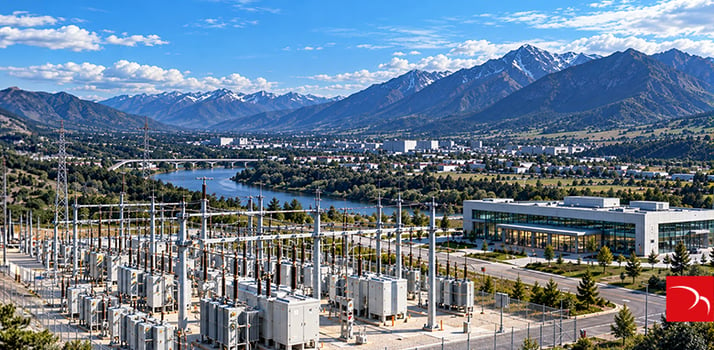
Utility networks are as critical to grid resilience as the physical grid itself. Today, utilities continually work at modernizing their infrastructure, from AMI and SCADA to distribution automation, renewable energy sites, substations, and field network operations. And one of the biggest challenges they face is keeping everything connected: field devices, aggregation points, control centers, substations and crews, especially when obstacles like distance, weather, interference, cyber risks, as well as legacy equipment get in the way. Intelligent utility networks leverage a combination of private LTE/5G, CBRS, microwave and mmWave wireless backhaul, edge intelligence and AI applications, and lifecycle services to move utilities from smart grid visibility to faster, near real-time, decisions, stronger outage response, and more resilient grid operations.
And a smarter grid needs a smarter communications layer, but smart technology alone isn’t the answer. The design question is not which technology sounds most advanced. It is where each layer best fits within the company’s infrastructure of access, transport/backhaul, core, and operations, so utilities can take advantage of field visibility and make faster, safer decisions.
The urgency is growing. J.P. Morgan forecasts $5.8 trillion of cumulative global grid investment between 2026 and 2035, with roughly $700 billion projected for digital grid capital expenditure. Digital investment only delivers operational value when utilities have the communications foundation to connect, monitor, and control the grid in real time.
Why The Grid Cannot Modernize on Legacy Communications Alone
Smart traditional utility communications were built around predictable power flows, centralized generation, and slower operational cycles. Modern distribution networks are different. Distributed energy resources, rooftop solar, battery storage, electric vehicle charging, and automated switching create more dynamic conditions across substations, feeders, and field assets.
Smart grid infrastructure depends on two-way data movement. Field devices report voltage, current, fault, and asset-health data. Distribution automation systems analyze local events and trigger switching or isolation. AMI head-end systems collect smart meter data from neighborhood aggregation points. SCADA, telemetry systems, teleprotection systems and outage management platforms need reliable connectivity before a minor disturbance becomes a larger service event.
This is why the communications layer is a grid resilience asset. If a substation goes silent, operators lose the field visibility, and they need to respond quickly. If a distribution automation device cannot communicate, fault isolation slows down. If AMI backhaul is unreliable, then demand-response systems, outage detection and restoration workflows become less accurate. The grid can only respond as fast as its communications network allows.
What Makes a Utility Network Intelligent?
A smart utility network is not just a collection of connected meters, sensors, radios, and routers. It is a layered communications architecture that connects field devices, local aggregation points, substations, control centers, and enterprise applications while maintaining a separation between operational technology and corporate IT.
In an AMI architecture, smart meters send usage and event data through a field area network to data collectors or neighborhood aggregation points. Those aggregation points then need dependable backhaul to AMI head-end systems, meter data management platforms, and utility operations centers.
In distribution automation, reclosers, capacitor banks, fault indicators, line sensors, and remote terminal units send operational data through access networks and backhaul links to SCADA, distribution management systems, and outage management workflows.
In practical terms, this is the difference between knowing a fault happened somewhere on the network and knowing where it happened, which assets are affected, what crews to dispatch, and how quickly service can be restored.
A smart utility network has four practical layers:
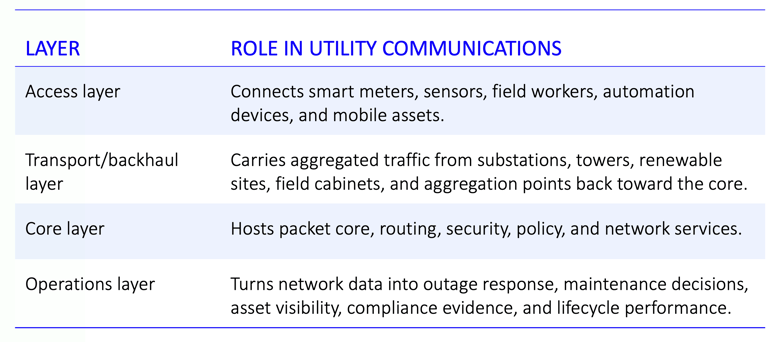
When these layers are designed together, connectivity becomes the operating system for grid awareness.
Different Grid Applications Need Different Network Behavior
Not every utility application places the same demand on the network. AMI interval reads can tolerate different timing than teleprotection, distribution automation, or fault isolation. Video from a remote substation has much higher throughput requirements than SCADA telemetry. Field workforce mobility has different coverage behavior than fixed microwave backhaul.
That is why network architecture must be planned around the operating requirement, not only the device type.
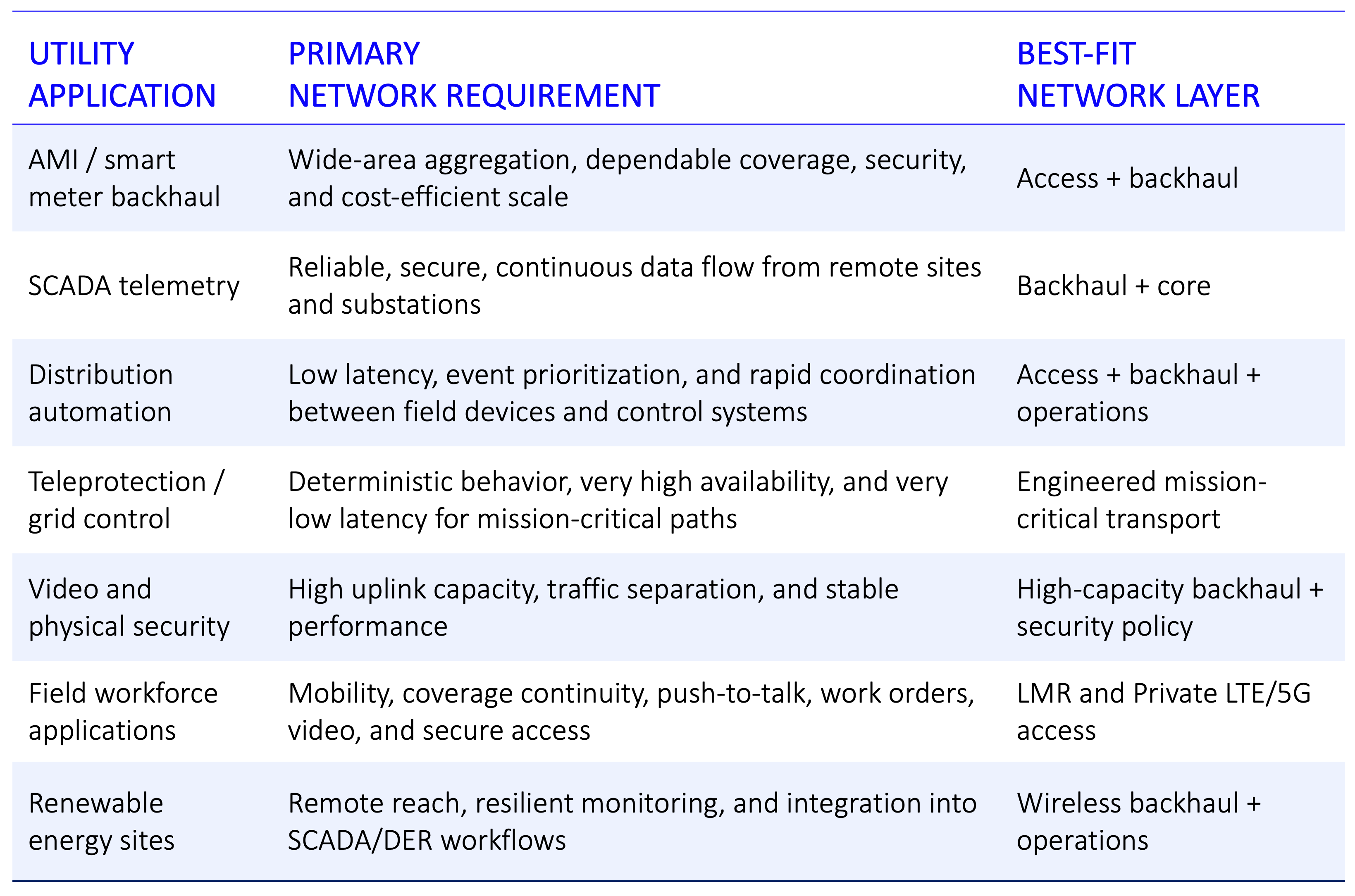
Protection-grade communications are commonly engineered toward very high availability, often 99.999% for mission-critical paths. Protection and control schemes require sub-10 millisecond end-to-end latency, depending on the application and system design. These performance requirements make network architecture a grid OT operations decision.
Why Fiber Alone Does Not Solve the Utility Connectivity Problem
The Fiber is valuable where it is available, protected, and economically practical. The challenge is that many of the hardest utility connectivity points are not in convenient locations. They may be substations outside urban fiber routes, renewable energy sites in remote areas, distribution automation devices along rural feeders, water facilities, or temporary restoration sites after storms, floods, or wildfires.
In those environments, the practical question is not whether fiber is valuable. It is whether fiber can be deployed fast enough, protected well enough, and justified economically for the use case.
Utilities often face:
- Video Long rural distances and sparse infrastructure
- Difficult rights-of-way and permitting delays
- High trenching costs and long construction timelines
- Storm, wildfire, and flood exposure
- Remote substations, renewable sites, and water facilities
- Temporary restoration needs after network damage
Utility microwave backhaul is the transport layer that carries aggregated operational traffic from substations, towers, field aggregation points, renewable sites, and remote facilities back toward the utility core, control center, or head-end systems. A hybrid wireless-fiber network model is the most resilient and robust architecture, widely adopted by utilities worldwide.
High-capacity wireless backhaul is often the practical transport layer for difficult-to-fiber routes. Microwave and mmWave links can connect substations, towers, control locations, renewable sites, and aggregation points without trenching. Wireless connectivity also gives utilities a path to temporary, redundant, or rapidly restorable connectivity when severe weather or construction damage disrupts wired infrastructure.
The goal is not to replace fiber everywhere. The goal is to build a layered utility network that uses fiber where it fits, wireless backhaul where reach and deployment speed matter, and private LTE/5G where utilities need dedicated access for field operations, automation, and mobility.
Edge Intelligence Helps Utilities See Trouble Earlier
Edge computing means processes data closer to the asset, whether at a substation gateway, field cabinet, aggregation site, or private network edge. AI-assisted operations can then detect patterns that are difficult to identify through manual monitoring alone.
For example, imagine a feeder experiencing repeated voltage irregularities. Without trusted field data and local processing, the utility may only see the pattern after customer complaints, manual review, or a larger outage. With edge intelligence, operators can detect the pattern earlier, narrow the likely cause, and send crews with better context.
For utilities, edge intelligence can support:
- Faster detection of abnormal load behavior
- Early identification of equipment degradation
- More precise outage localization
- AI-based predictive maintenance planning
- Better prioritization of field crews
- Improved monitoring of remote substations and renewable sites
- Local decision support when backhaul is constrained or disrupted
The practical value is not "AI" as a standalone concept. The value is faster operational awareness. A distribution automation system can isolate faults more quickly supplying when field data that can be trusted. A maintenance team can prioritize the right transformer, switch, or communications site when anomaly detection narrows the probable cause. A control center can make better restoration decisions when the network continues reporting during severe weather.
This is where Ceragon's utility work fits naturally into the architecture. Ceragon's utilities connectivity solutions combine high-capacity wireless transport, private LTE/5G, orchestration, and lifecycle services for utility environments where uptime, reach, and deployment speed matter.
From Deployment to Day-Two Performance: Orchestration Across the Field Edge
For utilities, the hard part is not only deploying a new network. It is keeping that network visible, secure, maintained, and aligned with changing grid operations over time.
Utilities already operate mixed fleets of field devices, legacy radios, SCADA assets, routers, sensors, and security tools. Intelligent utility networks need orchestration as much as capacity.
Midwest Energy shows how this plays out in utility network modernization. The vertically integrated electric and natural gas cooperative serves 50,000 electric customers and 42,000 natural gas customers across 40 counties in western Kansas, supporting power generation, transmission, distribution, SCADA operations, and reliable energy delivery across a wide service area. As portions of its legacy microwave network approached obsolescence, Midwest Energy upgraded the first 12 critical communications links from Ceragon IP-20 technology to the IP-50 platform through a streamlined single-supplier model.
The project modernized 12 critical microwave communications links, reduced procurement and project coordination complexity, and created a foundation for additional modernization phases, including seven more planned links. The operational lesson is straightforward: utility network modernization is easier to scale when the transport layer, deployment model, and lifecycle plans are designed together.
Many utilities manage dispersed substations, SCADA sites, transmission and distribution assets, as well as rural service territories. For them to modernize, the challenge is not only bandwidth but it is replacing aging infrastructure while preserving continuity, reducing vendor coordination, and keeping the network ready for future operational requirements.
Ceragon's acquisition of E2E Technologies extends this capability from wireless performance into full-lifecycle industrial connectivity, integration, and management. The operational value is the connection between field design and day-two performance: consulting, network design, deployment, software integration, training, monitoring, maintenance, and support.
This is important because intelligent utility networks are not one-time builds. A private LTE/5G access layer may support workforce mobility and distribution automation. Microwave backhaul may connect substations and renewable sites. Edge analytics may support predictive maintenance. A management platform may give operators a unified view of performance and faults across multi-vendor infrastructure.
The result is a more complete utility network solutions model:
- Connectivity: High-capacity wireless transport and private LTE/5G access.
- Coverage: Wide-area reach across substations, distribution assets, water facilities, renewable sites, and remote locations.>
- Orchestration: Visibility and control across connected infrastructure.
- Lifecycle support: Design, deployment, monitoring, maintenance, and training.
- Operational intelligence: Analytics that turn field data into earlier decisions.
This is the shift from smart grids to end-to-end connectivity, where real-time data flow, distributed assets, monitoring, and control depend on the communications network underneath them. To go deeper on what this looks like in practice, Smart Grids, Brilliant Connectivity: End-to-End Networks for Utilities is Ceragon’s eBook covering the journey from grid decentralization to intelligent, connected operations.
The Intelligent Grid Is Built One Use Case at a Time
For the path to an intelligent utility network does not require a single disruptive cutover. Most utilities modernize by use case.
- For substations, the priority may be resilient backhaul, traffic handling, secure remote access, and monitoring.
- For AMI/smart meter backhaul, the priority may be wide-area aggregation and cost-effective coverage.
- For distribution automation, the priority may be latency, availability, and event prioritization.
- For renewable energy sites, the priority may be connecting remote solar, wind, or battery assets into SCADA and DER management workflows.
- For field workforce systems, private LTE/5G can support mobility, push-to-talk, work orders, video, and situational awareness across broad service territories.
This For U.S. utilities, CBRS can also be part of the private network access layer. CBRS operates in the 3.5 GHz band and can support private LTE/5G deployments where utilities need dedicated wireless coverage for internal operational use cases. In utility environments, CBRS-based private networks can support distribution automation, remote substation operations, AMI, and workforce management when paired with the right transport and management architecture.
A practical modernization sequence looks like this:
- Identify the operating constraint: outage response, remote visibility, AMI scale, renewable integration, or workforce mobility.
- Classify the traffic: protection, SCADA, AMI, IIoT, video, mobile workforce, or enterprise data.
- Map the architecture: access, backhaul, core, operations, and management.
- Apply compliance requirements: IT/OT segmentation, access control, logging, redundancy and auditability.
- Add intelligence where it improves decisions: analytics, edge processing, predictive maintenance, or automated fault detection.
- Build for lifecycle performance: monitoring, maintenance, training, and expansion.
This staged approach helps utilities modernize without replacing every system at once.
From Visibility to Action: The New Baseline for Grid Resilience
For The next stage of grid resilience will not only be measured by uptime, but also by awareness. A resilient smart grid detects abnormal conditions earlier, routes data through available paths, supports secure remote operations, and gives operators a reliable view of field reality during the moments when visibility matters most.
Intelligent utility networks turn connectivity into coordination. They connect substations, AMI collectors, distribution automation devices, renewable sites, water facilities, and mobile teams through a communications architecture designed for the physical, regulatory, and operational realities of utility work.
Grid modernization is no longer a question of adding more connected devices. It is making every connected device part of a secure, observable, and responsive operating system for the grid. That is where smart grid solutions become a grid resilience infrastructure, and where utility network solutions become a long-term operational advantage.
Key Takeaways for Utility Networks
- Lifecycle Grid modernization depends on communications infrastructure that is secure, resilient, and designed for OT- operational technology environments.
- A smart utility network connects field devices, aggregation points, substations, control centers, and analytics systems across access, backhaul, core, and operations layers.
- Grid resilience depends on matching each application to the optimal bandwidth, availability, and security requirements.
- Fiber remains important, but wireless backhaul and private LTE/5G help utilities reach remote, rural, mobile, and difficult-to-fiber assets.
- Edge intelligence and AI-assisted operations improve awareness by detecting patterns earlier and supporting faster decisions.
- Ceragon extended utilities portfolio combines utility-native engineering, in-house deployment capabilities, managed services, integrated network and edge devices operational management, and industry-leading wireless connectivity into a single accountable partner.
- Ceragon’s utility network modernization work includes Midwest Energy’s upgrade of 12 critical microwave links from legacy IP-20 technology to the IP-50 platform, creating a scalable foundation for additional planned modernization phases.
Explore the Next Step in Utility Network Modernization
Grid resilience depends on more than connected devices. It depends on secure, high-capacity communications that can support AMI, SCADA, IIoT, distribution automation, field workforce systems, renewable sites, water facilities, and future grid intelligence.
Download Ceragon's Smart Grids, Brilliant Connectivity: End-to-End Networks for Utilities eBook to learn how utilities can build smarter, more resilient networks from the field edge to the control center.
FAQs - Intelligent Utility Networks
Q1: What is an intelligent utility network?
A: An intelligent utility network is a layered communications architecture that connects grid field devices, substations, AMI systems, distribution automation assets, renewable sites, control centers, and analytics platforms. It helps utilities sense, analyze, and respond to operational conditions more quickly and securely.
Q2: How is an intelligent utility network different from a smart grid?
A: A smart grid uses digital devices, automation, and data to improve grid operations. An intelligent utility network is the communications and orchestration foundation that allows those smart grid systems to exchange data reliably across field, backhaul, core, and operations layers.
Q3: Why is connectivity so important for grid resilience?
A: Grid resilience depends on visibility and control during normal operations and disruptive events. If substations, meters, automation devices, or field crews lose communications, operators have less information for outage response, switching decisions, restoration planning, and maintenance prioritization.
Q4: Where does private LTE/5G fit in utility networks?
A: Private LTE/5G can support utility field workforce applications, distribution automation, mobile operations, video, push-to-talk, and broadband connectivity across wide service areas.
Q5: What is the difference between access and backhaul in utility communications?
A: The access layer connects end devices such as smart meters, sensors, workers, and automation equipment. The backhaul layer carries aggregated traffic from substations, towers, renewable sites, or field aggregation points back toward the utility core, head-end systems, or control center.
Q6: How do edge intelligence and AI help utilities?
A: Edge intelligence processes data closer to the asset, while AI-assisted operations identify patterns such as abnormal load behavior, equipment degradation, repeated voltage events, or communication instability. This helps utilities move from reactive troubleshooting to earlier detection and better operational decisions.
Q7: How does Ceragon support smart utility network modernization?
A: Ceragon supports utility network modernization through high-capacity wireless backhaul, private LTE/5G connectivity, industrial network integration, orchestration, and lifecycle services. The goal is to help utilities connect field assets, massively deploy IIoT devices, improve visibility, support compliance-aware operations, and modernize at a practical pace.
Q8: How does microwave backhaul support utility network modernization?
A: Microwave backhaul supports utility network modernization by connecting substations, SCADA sites, field aggregation points, renewable energy sites, and remote facilities where fiber is unavailable, slow to deploy, or difficult to justify economically. In Midwest Energy’s modernization program, 12 critical microwave links were upgraded from legacy IP-20 technology to Ceragon’s IP-50 platform to refresh aging infrastructure and simplify deployment through a single-supplier model.