

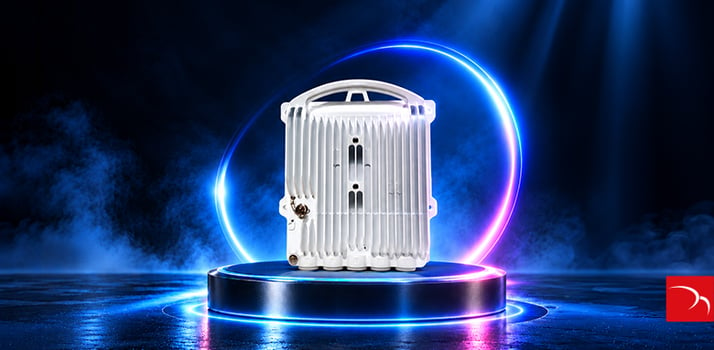
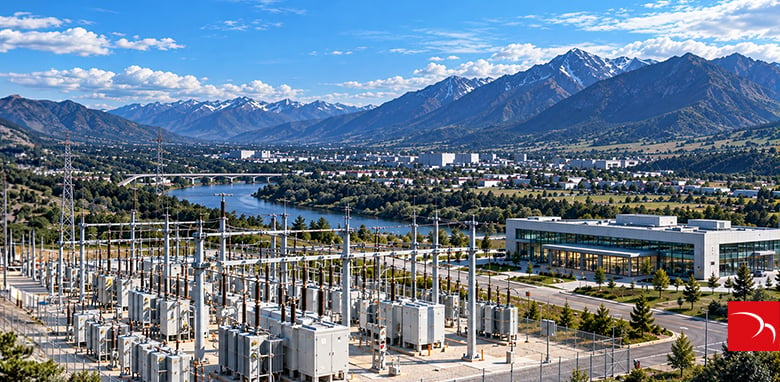
Most utility communications networks were built to support a grid that no longer exists. Seventy percent of the U.S.'s transmission lines and power transformers are already 25 years or older, and the carriers some of those networks still lease circuits from are actively retiring the legacy TDM and analog services underneath them. This doesn't mean your network is going to crash today, but the risks keep growing even when the network appears to be working just fine. Utilities that wait for a forcing event can end up modernizing reactively, under tighter timelines and with fewer options. Modernization is not about completing every upgrade before the end of one leader’s tenure. It is about leaving the next team coming up with fewer unsupported technologies, a clearer architecture, and a practical roadmap already underway.
"If [the Network] Ain't Broke, Don't Fix It?"
We've all heard the old adage before. For the utility leaders making decisions about their communications networks today, though, it doesn't quite hold true.
Communications networks are the backbone of every utility, carrying the signals and enormous amounts of data that actually make things happen...things like opening breakers, tripping relays, and ultimately, keeping the lights on. Making a bunch of changes to something that still works IS a legitimate concern. But frankly, it's also a risk calculation every utility leader must consider.
Just because a legacy network is still "working," doesn't mean it's safe to simply let it ride, especially when it comes to critical infrastructure. A network can meet every requirement it was originally built for 20-30 years ago, AND still be quietly lagging behind new requirements for capacity, security, latency, and regulatory compliance that nobody had even considered when it was first installed. That's where this conversation really needs to start.
The Physical Grid Is Changing Faster Than Its Communications Backbone
Much of the physical grid that aging communications networks were built to support is still there — the transformers, breakers, and transmission lines it relies on are the same ones, decades old and climbing. More than a quarter of U.S. grid infrastructure is at least fifty years old. And per the American Society of Civil Engineers, 70% of the nation's power transformers and transmission lines are 25 years or older, and 60% of circuit breakers are 30 years or older — aging hardware that earned the U.S. energy grid a D+ on ASCE's most recent infrastructure report card.
Meanwhile, what utilities are now asking their networks to carry has changed dramatically. Distributed solar, EV chargers, and behind-the-meter batteries are pushing intelligence, and traffic, out to the grid edge faster than most communications architectures were designed to handle. In fact, DER investment is projected to grow 75% by 2030, and roughly 22 million EVs could be on U.S. roads by then. Every new and advanced endpoint needs to be seen, measured, and controlled, which means each one places more demand on the communications layer that, in many utilities, predates the concept of a "grid edge" entirely.
The network was never the headline; it has always been the enabling layer underneath automation, resilience, and visibility. But all of those things depend on the communications infrastructure underneath them.
Understanding the Utility Communications Network's Role: From Field Devices to the Control Center
Modern utility communications networks, like any network carrying traffic for critical infrastructure, are built in layers. Each layer carries a different mix of traffic with its own latency and security requirements. Field devices such as protection relays, RTUs, AMI meters, and DER inverters connect to a substation or aggregation point, where traffic is consolidated before moving to the transport layer, typically fiber and point-to-point microwave backhaul spanning a utility's substations and transmission corridors. That transport ends at the control center, where SCADA, DMS, and OMS systems act on the data.
Fiber remains essential to utility communications, but it cannot always reach every remote substation, renewable site, or rural asset quickly or cost-effectively. A layered architecture combining fiber with microwave, millimeter wave, and private wireless allows utilities to extend coverage, add resilience, and modernize critical links without waiting for a complete network rebuild.
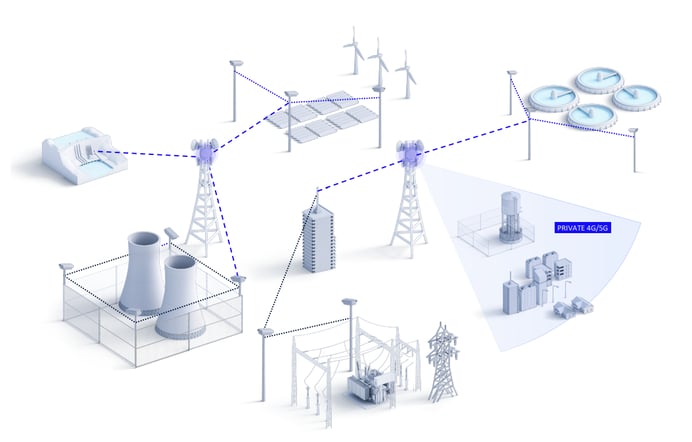
Protection traffic has some of the strictest performance requirements on the network. For demanding applications such as line current differential protection, latency needs to stay below roughly 10 milliseconds. AMI and DER telemetry can tolerate more variability. NERC CIP compliance also requires clear IT/OT segmentation between operational and corporate systems across the network, not just at the control-center perimeter.
Why Legacy Communications Infrastructure Creates Compounding Risk
A network that still passes daily operational tests can be accumulating risk that never actually shows up on a daily dashboard check. Four risks can grow quietly underneath a network that still seems "good enough":
-
TECHNOLOGY LIFECYCLE: most carriers are retiring TDM systems that some utilities still lease from them, and aging microwave radios built on TDM architecture are approaching end of life industry wide.
-
RISING COMPLEXITY: new capacity and bandwidth-heavy applications are increasingly running alongside decades-old TDM and SDH infrastructure, adding operational complexity, even where each one still individually functions adequately.
-
RESILIENCE UNDER CHANGING WEATHER & CLIMATE CONDITIONS: 2024 saw 27 separate billion-dollar weather disasters in the U.S. totaling roughly $182.7 billion, the fourth-costliest year on record. The networks engineered to stand up to yesterday's storms are facing a new, much more intense, more frequent reality.
-
SECURITY CONCERNS AND COMPLIANCE DEMAND: NERC CIP-013 is the supply-chain risk-management standard approved by FERC and enforced through the NERC compliance framework, with penalties of up to $1 million per day, while ransomware attacks on the energy and utilities sector rose 80% in 2024 alone and NERC reports vulnerable points in North American grids growing by roughly 60 per day.
What does this all mean? It doesn't necessarily mean your network will fail tomorrow, but it DOES mean there's a growing risk in accepting "good enough" for too long.
What a Modern Communications Network Foundation Makes Possible
Modernization is not just about replacing aging technology. It is about creating a communications foundation layer that supports today’s operational needs while preparing the grid for what comes next. A modern network enables:
- Greater visibility across substations and remote assets
- Reliable support for protection, SCADA, video, and automation
- Faster integration of DERs and new grid applications
- Stronger resilience and security
- A scalable foundation for future operational intelligence
Delaying Modernization Doesn't Remove the Risk, It Simply Delays It
Like most decisions in life, it can be tempting to treat modernization as something that can wait. But every year you delay the start can make the full project bigger, more complex, and more urgent.
The question isn't just whether to modernize. It's whether you get to do it on your own terms.
A utility that chooses to begin network modernization now gets to set its own pace and can work with its existing architecture. One that waits for a major event to hit such as a vendor shutdown, a compliance deadline, a major storm may end up facing the same modernization project, only under much more pressure. Starting the process earlier gives utilities more control over the timeline, priorities, and investments they choose to make.
Modernization Doesn't Always Mean Rip-and-Replace: A Step-by-Step Path from Legacy Equipment to Modern Infrastructure
The instinct to delay is often less about denying the need is there, than it is about overestimating the size of the undertaking. We get it - "network modernization" is a big, daunting term. And it sounds expensive.
But frankly speaking, a full network overhaul all at once IS admittedly risky for a critical-infrastructure operator. But it also isn't the only option. A more practical model takes modernization in stride:
-
TAKE INVENTORY
Establish end-to-end visibility and monitoring across existing and future assets, including both sensors and network infrastructure, to understand what is running where, its condition, and its remaining service life. -
IDENTIFY THE HIGHEST-RISK SPOTS
Note all compliance and operational exposures too, not just the oldest hardware. -
PRIORITIZE PROTECTION AND SCADA PATHS FIRST
Line current differential protection requires end-to-end latency under 5 milliseconds; direct transfer trip schemes allow up to 10. These figures explain why utilities cannot simply drop mission-critical traffic onto "best effort" carrier networks, but need a private network to work for them instead. -
BUILD A MULTI-YEAR ROADMAP
This kind of undertaking shouldn’t be a single procurement event. -
INTEGRATE RATHER THAN REPLACE
Many utilities migrate substation and backhaul links from SDH/TDM to microwave or millimeter wave with IP/MPLS, preserving deterministic protection performance while gaining packet flexibility.
A phased approach allows utilities to modernize critical communications while maintaining service continuity. Legacy and new infrastructure can coexist during the transition, enabling teams to migrate one link or traffic group at a time while keeping protection, SCADA and other operational services running.
Each phase can be tested and validated before proceeding, with clear rollback plans to reduce risk. This helps utilities modernize with minimal, or zero, service interruption while spreading investment and operational change over time.
Case In Point: Midwest Energy
Midwest Energy, an electric and natural gas cooperative serving 50,000 electric customers across 40 counties in western Kansas, modernized this way. Nearly a decade after its original network deployment, it upgraded its first 12 critical microwave links from legacy IP-20 equipment to a current-generation platform through Ceragon, as a single-vendor process, with seven more links already planned for the next phase.
And federal funding tailwinds, like the DOE's $10.5 billion GRIP program, are making that kind of phased case easier to build.
A phased program still requires coordination across network assessment, RF planning, site surveys, tower work, deployment, OT integration, and ongoing support. Consolidating these responsibilities under one accountable partner can reduce handoffs, accelerate migration, and avoid the finger-pointing that often accompanies multi-vendor projects.
What the Next Leadership Team Inherits
There's a reason "legacy" fits both halves of this problem: the network you inherited, and the one you'll leave behind.
The measure of a well-led modernization effort isn't whether one leader personally completes a full network replacement. It's what the next team inherits: a resilient foundation instead of a shrinking list of vendor-supported parts, an architecture with a clear logic instead of decades of patched-together exceptions, and a roadmap already in motion instead of a blank page.
Utilities already think about physical assets in terms of decades. Their communications infrastructure deserves the same long-term thinking. Nobody expects one leadership team to rebuild the power grid. But each one can leave it — and the network underneath it — better prepared than they found it.
Starting the Right Transformation
The most defensible position a utility leader can take isn't "we haven't needed to change yet." It's "we started preparing before we had to."
Network modernization doesn't have to happen all at once. The important decision is to start with the right priorities, the right roadmap, and a baseline network architecture designed for where the grid is going, not just where it's been.
For a closer look at how utilities are approaching this transition in practice, Ceragon's on-demand webinar with Marcus Evans is a useful, no-commitment starting point.
Utility Network Modernization - FAQs
Q1: Does modernizing a utility communications network mean replacing everything at once?
A: No. A phased approach is standard practice: inventory the current environment, identify the highest-risk gaps, prioritize by operational risk, build a multi-year roadmap, and integrate new packet-based infrastructure alongside existing systems rather than a single disruptive cutover. Midwest Energy modernized this way, upgrading its 12 highest-priority microwave links first and planning seven more for a later phase.
Q2: What does a typical utility communications network architecture look like?
A: Field devices — protection relays, RTUs, AMI meters, DER inverters — connect into a substation or aggregation point. That traffic crosses a transport layer, typically fiber and point-to-point wireless backhaul, and terminates at the control center or head-end, where SCADA, DMS, and OMS systems act on it. NERC CIP-driven IT/OT segmentation applies across every layer, not just at the control-center perimeter.
Q3: What latency does teleprotection require over a utility communications network?
A: Requirements vary by application. For protection communications within a substation, latency should typically be below 5 milliseconds. For substation-to-substation protection, it can generally range from below 8 to 12 milliseconds, depending on the protection scheme, as outlined in IEEE 1646 and IEC TR 61850-90-12.