


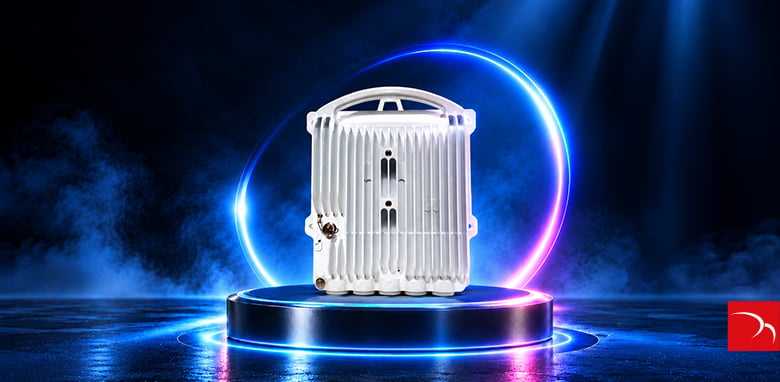
E-band wireless backhaul has traditionally required operators to perform a balancing act, accounting for link distance and availability, capacity, and deployment flexibility in their planning. The new IP-50EXA-P addresses that delicate balance directly, with 27 dBm transmission (Tx) power, up to 20 Gbps capacity in a 2+0 cross-polarization interference cancellation (XPIC) configuration, and high-efficiency Layer 1 aggregation for E-band and multiband deployments.
What exactly does this mean? More link budget to play with to push E-band farther, more capacity to keep up with growing traffic, and the flexibility to combine E-band with microwave for greater resilience, including microwave radios already in the network, whether they’re from Ceragon or another vendor.
Think of it as the best of ALL worlds: high-power E-band for greater engineered reach, multi-gigabit capacity, and multiband flexibility and resilience, all in one platform.
| Capability | What IP-50EXA-P Brings | What It Means for the Network |
|---|---|---|
| E-band reach | Up to 27 dBm Tx power | Better link budget to support longer link distances, availability, or capacity |
| High capacity | Up to 20 Gbps in 2+0 XPIC | Scale up E-band capacity without requiring an IDU |
| Multiband resilience | Layer 1 aggregation with microwave | Combine high-capacity E-band with the more resilient propagation characteristics of microwave |
| Brownfield flexibility | Supports Ceragon and third-party microwave | Add E-band capacity without replacing microwave infrastructure already deployed in the network |
Push E-Band Farther with 27 dBm Tx Power
E-band at 70/80 GHz delivers the wide channels needed for high-capacity wireless transport. But anyone who designs E-band links knows the age-old challenge: rain attenuation, antenna gain, fade margin, path length, and availability targets all affect how far a link can reliably go.
That’s where more power can make a big difference.
IP-50EXA-P delivers up to 27 dBm Tx power, which is 3 dB higher than the Tx power of IP-50EXP.
For network planners, that extra bit of margin creates options. It can be used to extend engineered link distance, increase fade margin, pursue higher availability, or sustain higher modulation levels longer as RF conditions deteriorate.
With optional 2 ft and 3 ft E-stabilizer antennas, IP-50EXA-P can support E-band link distances comparable to traditional microwave systems under appropriate link-design conditions. Actual engineered distance depends on factors including rain zone, antenna size, channel bandwidth, modulation, receiver threshold, path geometry, and availability objectives.
There’s no single distance number for every E-band link. The difference is that IP-50EXA-P gives planners more link-budget margin to work with from the start.
Scale to 20 Gbps—Without Adding an IDU
IP-50EXA-P supports up to 10 Gbps in 1+0 and up to 20 Gbps in a 2+0 XPIC configuration. XPIC enables two carriers using orthogonal polarizations to operate over the same path, providing a straightforward way to scale E-band capacity as traffic grows.
A 2+0 configuration requires just two outdoor units, no indoor unit required.
That can make a meaningful difference at sites where cabinet space, cabling, power, tower loading, and installation complexity can turn a seemingly simple capacity upgrade into a much bigger project.
Behind that flexibility is high-efficiency Layer-1 aggregation, which combines radio carriers at the physical layer so their capacity can work together as one coordinated transport resource.
The same Layer-1 aggregation capability also enables IP-50EXA-P to combine E-band and microwave in multiband architectures.
Go Multiband—Even with the Microwave You Already Have
High-capacity E-band and resilient microwave don’t have to be an “either/or” decision.
In a multiband setups, E-band provides the high-capacity layer, while lower-frequency microwave provides a transport path with more resilient propagation characteristics when severe attenuation reduces available E-band capacity. IP-50EXA-P uses Layer-1 aggregation to combine E-band and microwave capacity at the physical layer.
Operators can put that architecture to work in several configurations:
- 2+0 E-band: Two IP-50EXA-P radios deliver up to 20 Gbps using XPIC, without an IDU.
- 3+0 multiband with IP-50CX: Add IP-50EXA-P as a high-capacity E-band layer alongside a current-generation Ceragon microwave link.
- 3+0 multiband with IP-20C: Add E-band capacity while preserving an existing Ceragon microwave deployment.
- 2+0 multiband with third-party microwave: Add IP-50EXA-P alongside an existing non-Ceragon microwave radio.
That last option is especially important for brownfield networks.
IP-50EXA-P can add E-band capacity and Layer-1 multiband capabilities alongside supported existing Ceragon or third-party microwave radios, without requiring operators to replace the microwave infrastructure first.
Long story short, upgrading the network doesn’t have to mean rebuilding it.
More Capacity When Conditions Allow. More Resilience When They Don’t.
More Tx power gives IP-50EXA-P a stronger link budget to start with. But weather still matters when we’re talking E-band, and that’s where the rest of the architecture comes into play.
IP-50EXA-P supports Adaptive Coding, Modulation, and Bandwidth (ACMB) to adapt link capacity as RF conditions change.
Modulation adaptation allows the link to operate at a lower required signal level when conditions deteriorate, while bandwidth adaptation can reduce occupied channel bandwidth when the full configured channel can no longer be supported.
Instead of moving immediately from full capacity to link failure, the link can trade capacity for additional robustness as conditions change.
Optional 2-ft. and 3-ft. E-stabilizer configurations address another E-band challenge: antenna alignment. Because beamwidth is extremely narrow at 70/80 GHz, wind, vibration, or tower movement can affect received signal levels. Stabilization helps keep those highly directional antennas aligned.
And in a multiband deployment, microwave adds another layer of resilience by providing a transport path with different propagation characteristics.
To put it all together:
- 27 dBm Tx power provides better link budget.
- ACMB adapts capacity as RF conditions change.
- E-stabilization helps maintain antenna alignment.
- Layer-1 multiband aggregation combines high-capacity E-band with the resilience of microwave.
One E-Band Platform. More Ways to Build the Link.
There isn’t one “right” E-band deployment, and that’s exactly the point.
For a rural or longer-distance link, the key capability may be 27 dBm Tx power and the additional link-budget margin it provides.
For 5G backhaul, it may be up to 20 Gbps capacity, dual 25 GbE interfaces, Synchronous Ethernet (SyncE), and IEEE 1588v2 timing support.
For a dense urban site, it may be reaching 20 Gbps without adding an indoor unit or consuming more cabinet space.
And for a brownfield network, it may be the ability to add high-capacity E-band alongside an existing Ceragon or third-party microwave deployment instead of starting over.
IP-50EXA-P brings together up to 27 dBm E-band Tx power, up to 20 Gbps capacity in 2+0 XPIC, and Layer 1 aggregation for E-band and multiband architectures. For operators, that means more ways to design around the requirements of each link—whether the priority is reach, capacity, resilience, or preserving existing infrastructure and investments.
That’s the real advantage of IP-50EXA-P: more options for building the link you need.
Want to know more? Read about how Fybercom expanded its rural broadband capacity without additional spectrum, fiber, or operational complexity.




