


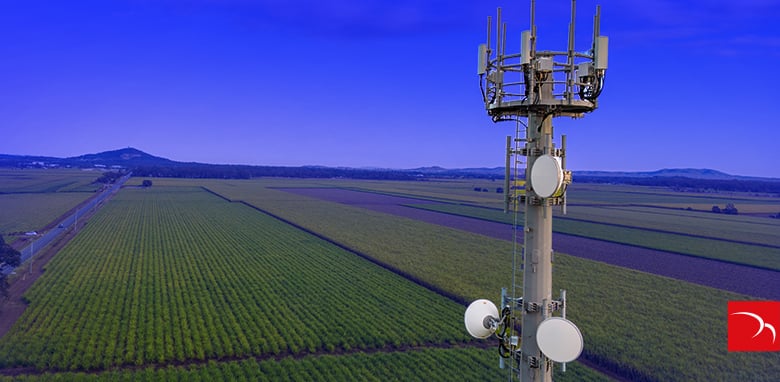
The race to expand 5G networks across rural areas is more than a matter of meeting market demand. Reliable, high-speed connectivity has become essential to bridge the digital divide, power economic growth and enable communities to access critical services, from telemedicine to e-learning.
Fiber is often non-existent in rural areas, and traditional microwave solutions do not typically offer the capacity needed. Another option, deploying ultra-high capacity mmWave, presents its own unique set of challenges for mobile operators. These challenges are often amplified by a lack of stable tower infrastructure.
While the promises of 5G in rural areas are immense, delivering on them requires innovative strategies and forward-thinking technologies to overcome these obstacles. The question remains: how do we affordably ensure stable, high-capacity connectivity in areas where infrastructure limitations like monopoles and environmental conditions work against us?
What you will learn:
• Challenges Tier-1s Face in Building Out Rural Sites
• Innovative Auto-Aligning Solutions for Sway-Prone Infrastructure
• Real-World Success Story
• The Future of Rural and 5G Connectivity
• FAQs
• Key Takeaways
Challenges for Tier-1s in Building Out 5G Rural Sites
Rural areas often lack the dense, robust infrastructure that urban environments enjoy. In fact, according to the U.S. Department of Agriculture (USDA), citing FCC data, over 22 percent of Americans in rural areas and 27.7 percent of people in Tribal lands lacked coverage from fixed terrestrial broadband, compared to about 1.5 percent of urban residents.
Fiber and Microwave Challenges
- Fiber, perhaps the gold standard for delivering high-capacity connectivity, is rarely an option in rural areas due to the high costs and delays associated with trenching and permitting.
- Traditional microwave spectrum struggles to scale in these environments due to interference and limited capacity.
What about Millimeter Wave? Alignment Challenges on Sway-Prone Monopoles
Although millimeter wave (E-band) can deliver speeds up to 10+ Gbps, network engineers often worry about maintaining its high-frequency narrow beam alignment. One key issue lies in the very transmission towers often used to deploy them. Monopoles, or single-pole structures, are a common fixture in rural areas due to their availability, affordability, and smaller footprint.
However, these structures are inherently less stable than lattice towers. They tend to sway with the wind or move subtly with changing temperatures, resulting in alignment shifts that disrupt signal performance.
This inherent tower instability can present challenges for engineers, including:
- Frequent Signal Misalignments: Even slight tower movements can cause a loss of alignment, leading to signal degradation or complete outages.
- Costly Maintenance: Operators may resort to frequent truck rolls and manual realignments to restore performance, driving up operational expenses (OPEX). Industry estimates show that a single truck roll can cost from several hundred dollars to over $1,000 depending on location, labor, and time on site.
- Service Disruptions: Connectivity outages compromise user experience and, in critical cases like telemedicine or emergency services, can have serious consequences.
Innovative Auto-Aligning Solutions for Sway-Prone Infrastructure
Fortunately, Ceragon is stepping in with advanced technology to address these challenges. Smart innovations such as real-time antenna auto-alignment systems are paving the way for rural deployments, making it easier than ever to roll out cost-effective, high-performance 5G networks.
These solutions ensure that wireless engineers can utilize advanced wireless technologies like E-band to deliver reliable, lightning-fast speeds despite infrastructure limitations.
Ceragon’s auto-aligner technology is a prime example of this innovation in action. The auto-aligner continuously monitors and adjusts antenna alignment in real time, counteracting the natural sway and movement of monopole structures.
This not only eliminates the need for manual realignments but also ensures long-term link stability for ultra-high capacity backhaul.
Real-World Success Story
The effectiveness of this technology was demonstrated and embraced by a leading U.S. mobile operator. This tier-1 faced several challenges:
- Needed to expand high-capacity 5G coverage to rural areas with limited tower infrastructure (monopoles)
- Had no existing fiber access in the area
- Required 10 Gbps per site, unachievable with traditional microwave
- Needed link reliability, previously thought to be unachievable with E-band/mmWave
- Needed to keep costs under control
On the recommendation of Ceragon, this operator was strongly considering ultra-high capacity E-band backhaul on the existing monopoles for their rural 5G expansion. Their concern? Monopole sway would cause frequent mmWave misalignments, leading to service disruptions and expensive maintenance.
But after deploying Ceragon’s E-band radios paired with an innovative antenna auto-aligner technology, the operator achieved a stable, 10 Gbps per site without the need for costly infrastructure overhauls or constant realignment maintenance.
And the final results were striking:
- Long-term link stability, even on the inherently unstable monopoles
- Significant reductions in operational costs by eliminating the need for constant manual realignments
- Seamless integration with existing infrastructure for lower cost, rapid deployment
This technological breakthrough proves that operators no longer need to choose between affordable infrastructure and reliable performance. With the right technologies, even the most challenging environments can support the ultra-high capacity demands of 5G networks.
The Future of Rural & 5G Connectivity
Looking ahead, the potential for rural connectivity is limitless. With the right mix of innovative technology and strategic partnerships, operators can solve today’s challenges while preparing for tomorrow’s demands. Advanced auto-alignment systems, multi-band solutions, and enhanced network automation will continue to make ambitious deployments possible, even in the most infrastructure-limited locations.
We just gotta keep thinking outside the box.
For communities, this could mean not just faster internet, but entirely new opportunities—from smarter agriculture powered by IoT devices to digital classrooms that reach every student regardless of geography. The impact of 5G goes beyond speed; it’s about creating a more connected, digitally inclusive world.
Ceragon’s innovation of E-band plus auto-aligner technology is just the beginning. It points to a broader future where no location, no matter how remote, is left behind in the move towards next-generation connectivity. By addressing the challenges head-on and leveraging groundbreaking innovation, operators can turn the dream of 5G-for-all into a reality.
Interested in reading the full story of how one tier-1 U.S. operator is deploying mmWave plus auto aligners to solver their rural connectivity challenges?
FAQs
Q: Why should mobile operators consider using mmWave for 5G rural expansion?
A: Mobile operators should consider mmWave for rural 5G expansion because it delivers ultra-high capacity (10+ Gbps) without requiring extensive fiber infrastructure. When paired with auto-aligning antennas, mmWave enables reliable, cost-effective deployment on existing monopoles, allowing operators to rapidly expand coverage, meet growing demand for high-speed services, and future-proof networks for advanced applications.
Q: Why can mmWave be challenging to deploy in rural areas?
A: While mmWave can deliver ultra-high speeds (10+ Gbps), its narrow beam requires precise alignment. Rural sites often use sway-prone monopoles, which shift in the wind or with temperature changes, causing frequent signal misalignment and service disruptions.
Q: How do auto-aligning antennas solve alignment issues on monopoles?
A: Auto-aligning antennas continuously monitor and adjust the beam in real time, compensating for tower sway or movement. This ensures stable connectivity without frequent manual interventions, reducing operational costs and outages.
Q: Can Tier-1 operators deploy mmWave in lieu of fiber or microwave in rural areas?
A: Yes. E-band mmWave radios paired with auto-aligners can provide 10 Gbps backhaul over existing monopoles, eliminating the need for expensive fiber trenching while maintaining high reliability.
Q: What are the main benefits of using E-band mmWave with auto-aligners?
A: Benefits include:
- Stable, high-capacity links (up to 10 Gbps per site)
- Reduced operational costs from fewer maintenance truck rolls
- Faster deployment using existing infrastructure
- Support for critical rural applications like telemedicine and digital learning
- Lower capital costs when compared to fiber
Key Takeaways:
- mmWave is a strategic choice for rural 5G expansion, providing ultra-high capacity (10+ Gbps) without requiring extensive fiber, making it ideal for areas with limited infrastructure.
- Rural deployment challenges exist: Existing monopole towers (common in these areas) are sway-prone, and traditional microwave or fiber solutions can be costly or impractical.
- Auto-aligning antennas enable reliable connectivity: Real-time alignment adjustments compensate for tower movement, ensuring stable, high-capacity links and reducing operational costs.
- Cost-effective & scalable deployment: Operators can achieve 10+ Gbps per site on existing monopoles without expensive infrastructure overhauls, accelerating rural 5G rollout.
- Broad community and economic impact: Reliable, high capacity rural connectivity bridges the digital divide, supports modern applications like telemedicine and IoT, and fosters economic growth.
- Future-ready networks: Leveraging mmWave, auto-aligners and advanced backhaul technology prepares operators to meet growing demand for high-speed, next-gen services in rural regions.





