
When a wildfire crosses into a residential edge, a flood cuts off coastal roads, or a crowded public event turns into a multi-agency emergency response, the quality of your public safety communications network determines what responders see, how quickly various agencies can coordinate, and whether your first responders arrive informed or guessing. Agencies are moving beyond voice-only dispatch to public safety networks responsible for carrying live video, sensor alerts, drone feeds, dispatch traffic, and field intelligence in real time, even when fiber is unavailable or public cellular networks are congested.
That shift is already creating pressure on the network. Cited in our new public safety networks eBook, we found that 93% of public safety agencies reported network downtime during critical incidents in the past year, and 81% reported coverage gaps affecting emergency response. Obviously, these are stats that public safety agencies have a keen interest in improving.
Modern emergency communications planning also assumes interoperability, resilience, and coordination across jurisdictions. In the U.S., the CISA National Emergency Communications Plan frames emergency communications as a shared national capability that must support secure information exchange across agencies, technologies, and levels of government.
In the field, this means the network cannot go down and it cannot be looked at as a “passive” layer. It must become an active, critical part of the emergency response model.
Ceragon brings force to that model with high-capacity microwave, millimeter wave, private LTE/5G, and managed services that extend secure communications to the places where incidents actually happen: remote roads, coastal communities, outdoor or pop-up public venues, temporary command posts, and fiber-constrained city or suburb corridors.
And we can plan, rollout, and manage your network for you too. We’re already doing this for other cities around the world.
- Public Safety Communications Are Now Connected Device-Driven, Not Voice-Only
- Why Fiber Alone Cannot Support Every Public Safety Scenario
- Fiber vs. Wireless Backhaul for Public Safety Communications
- Wireless Backhaul Extends Visibility Where Incidents Happen
- Private Wireless Networks Give Agencies More Control During Congestion
- Real Deployments Show What Resilient Public Safety Networks Deliver
- Faster Deployment Is a Public Safety Requirement, Not a Convenience
- What Public Safety Leaders Should Prioritize Next
Public Safety Communications Are Now Connected Device-Driven, Not Voice-Only
Public safety used to be defined mainly by radio coverage and dispatch availability. Today, it is defined by connected visibility.
A single incident can trigger multiple bandwidth-hungry dataflows at once: HD 4K camera and surveillance feeds, drone video, body-worn camera data, emergency call-box traffic, license plate recognition, environmental sensor alerts, push-to-talk communications, and mobile command applications.
Individually, these are great tools. But connected through a resilient, private public safety network, they become one operational picture.
Every reliable link reduces uncertainty. Every second saved strengthens decision-making. A private, unified network turns fragmented field information into a full picture, and a full picture turns hesitation into action.
The weak link in this story is clear: if your network cannot carry heavy data from the edge to the command center without delay, agencies may own advanced cameras, analytics platforms, and dispatch systems, but will still lack that real-time situational awareness when it matters most.
Modern public safety communications need to support four practical requirements:
- Real-time situational awareness so responders do not arrive to incidents blind.
- High-capacity, low-latency video transport for bandwidth-heavy live surveillance, drone feeds, and incident monitoring.
- Resilient, prioritized connectivity when public networks are overloaded or congested.
- Coverage beyond where fiber can reach - remote, coastal, mountainous, temporary, historical, or high-density environments.
A public safety network is no longer just a communications utility. It is the operating layer that connects prevention, response, evidence, and recovery.
Why Fiber Alone Cannot Support Every Public Safety Scenario
Fiber remains essential for high-capacity fixed infrastructure, but fiber alone is not enough for modern public safety communications.
As we all know, public safety incidents are not predictable; they do not stay in areas where fiber is conveniently already available. They happen on coastal roads, in stadium parking lots, across mountainous terrain, in temporary evacuation zones, at outdoor festivals, and in underserved neighborhoods where fiber trenching may be too slow, expensive, or disruptive.
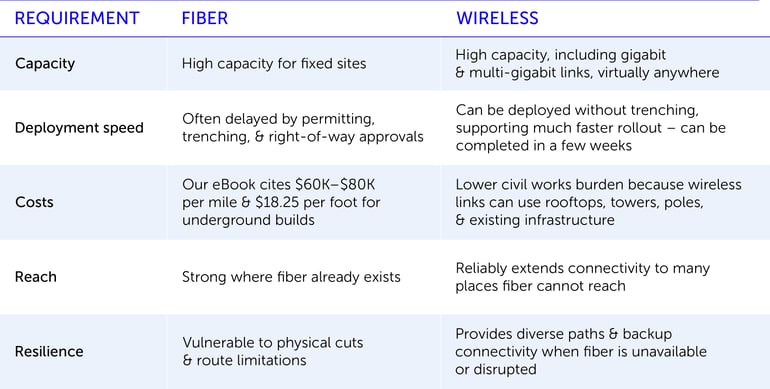
And the costs and timelines matter. Our new public safety eBook cites fiber deployment costs of $60,000 to $80,000 per mile, $800 to $1,200 per household passed, and a median underground build cost of $18.25 per foot. Labor can account for 60% to 80% of total fiber deployment cost, while permitting, trenching, and right-of-way approvals can delay projects by months or even years.
That delayed timeline does not match emergency response. Agencies cannot wait months for a fiber build when they need coverage for a disaster recovery zone, incident command post, temporary shelter, public event, or many new camera locations.
Wireless backhaul easily closes the gap fiber leaves behind. Microwave and millimeter wave links can extend high-capacity connectivity across rooftops, valleys, roads, rivers, coastal routes, and temporary operating areas without trenching.
Wireless does not replace fiber. Wireless completes the network by reliably extending fiber-like capacity, continuity, and reach to the edge. And it provides redundancy.
Real-Fiber vs. Wireless Backhaul for Public Safety Communications
Wireless Backhaul Extends Visibility Where Incidents Happen
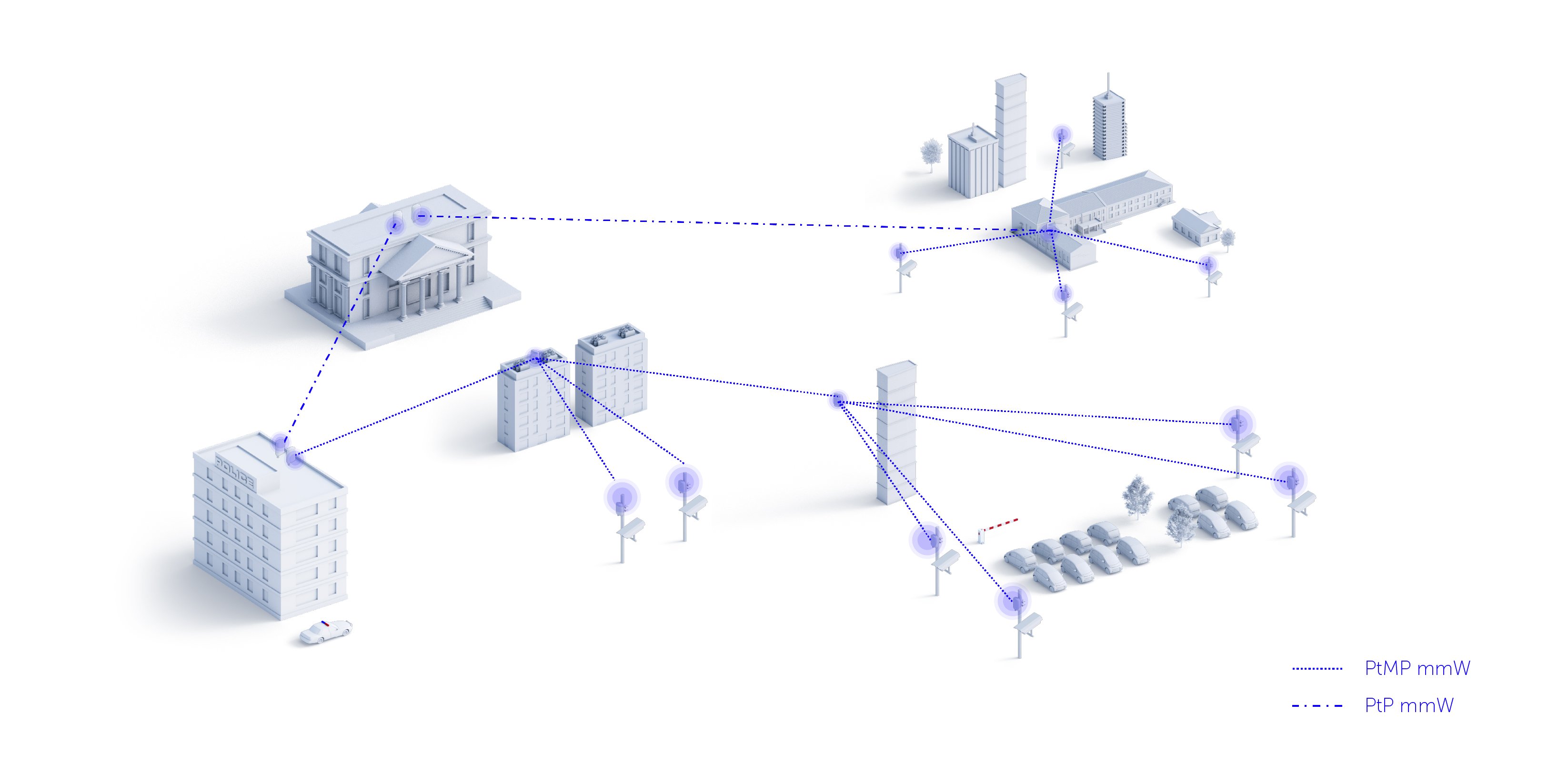
High-capacity wireless backhaul gives public safety agencies a practical way to move video, voice, and data between field assets, aggregation points, dispatch centers, emergency operations centers, and cloud or data center environments.
Microwave and millimeter wave links serve the transport layer. These dedicated links carry heavy traffic from cameras, body-worn devices, drones, vehicles, call boxes, towers, command posts, and edge sites back to core systems.
Private LTE/5G serves the access layer for secure mobility, field devices, and prioritized broadband.
Both layers matter, but they solve different problems. A camera, drone, or body-worn device may connect through an access network, but its value depends on whether the backhaul network is strong enough to carry the resulting data reliably to the people making decisions about what to do next. An end-to-end private network allows you to manage your data effectively, and always prioritize accordingly.
Secure Video Surveillance for Publis Safety Using MW and mmWave
Private Wireless Networks Give Agencies More Control During Congestion
Public networks are useful, but they are not always controllable.
During major incidents, commercial cellular traffic can surge as residents, visitors, media, and responders all compete for capacity in the same area. Public safety teams cannot allow mission-critical communications to be pushed to the back of the line.
That is why private LTE and private 5G are becoming a serious planning priority for agencies that need predictable bandwidth, traffic prioritization, secure mobility, and operational independence.
Private wireless networks help agencies keep control of communications performance in five ways:
- Dedicated bandwidth for mission-critical communications
- Traffic prioritization for voice, video, and command applications
- Secure connectivity for field teams and public safety assets
- Operational independence from congested public networks
- Reliable mobility for responders, vehicles, drones, and temporary command sites
And the market direction is consistent with broader critical communications network investment. A 2026 critical communications research bundle covers private LTE/5G, public safety LTE/5G, and mission-critical push-to-talk markets through 2030: Critical Communications 3 Report Research Bundle 2026.
For agencies, the issue is not whether public cellular has value. It does. The issue is whether public cellular alone can guarantee performance for mission-critical communications when demand spikes. Private wireless gives agencies an added layer of control.
Real Deployments Show What Resilient Public Safety Networks Deliver
The strongest case for private wireless public safety communications comes from operating environments where fiber constraints, public safety risk, and real-time visibility converge. Below are a few of our real-world deployments that showed quantifiable results.
Real-World Public Safety Wireless Deployment Proof Points
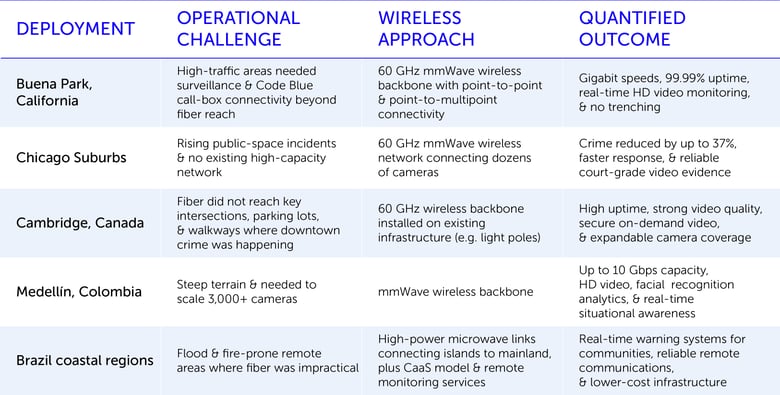
These deployments show the same pattern across different public safety environments: when fiber limits location, speed, or cost, wireless gives agencies a practical path to real-time visibility.
The operational implication is consistent: public safety camera placement strategy, emergency warning systems, and mobile command connectivity should be driven by risk and response requirements, not by the historical fiber map.
Faster Deployment Is a Public Safety Requirement, Not a Convenience
Temporary public safety operations create a different communications problem than permanent city infrastructure. A dispatch center or emergency operations center may require permanent, highly redundant connectivity. A wildfire staging area, flood response zone, public event perimeter, or mobile command post needs something different: fast deployment, flexible capacity, and the ability to move quickly as the incident changes.
This is where wireless shines. A rapidly deployable network featuring auto-aligning antennas is well suited for incident command posts, emergency shelters, temporary surveillance zones, disaster recovery sites, remote responder staging areas, large public events, and inter-agency interoperability links.
What Public Safety Leaders Should Prioritize Next
We know that public safety leadership is not reactive. It is deliberate. Intentional. Well-thought out. The systems protecting your community must work long before they are put to the test. That requires communications networks designed for pressure, not only for average operating conditions.
Our new public safety eBook identifies three major priorities for improving public safety connectivity: expanding network coverage to eliminate dead zones and reach needed camera locations, improving network reliability and resilience for uninterrupted emergency response, and reducing operational costs with more efficient and scalable connectivity solutions.
Those priorities should help guide public safety communications planning:
- Expand coverage where risk exists, not only where fiber already reaches.
- Design to avoid public network congestion or outages during disaster conditions.
- Use private wireless where agency control and prioritization matter.
- Use microwave and mmWave to extend fiber-like capacity connectivity quickly and cost-efficiently.
- Plan for managed network operations when internal network skills are limited.
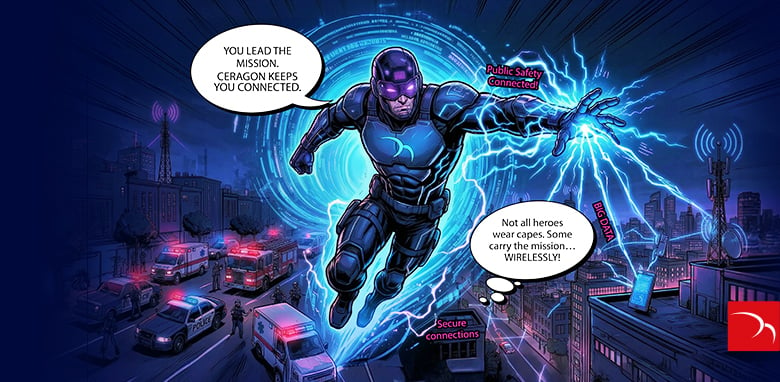
Wireless technology is the invisible force behind faster public safety response because it carries the information responders need before the scene is fully understood.
When video, voice, data, and field intelligence move reliably, agencies can act sooner, coordinate better, and protect communities with greater confidence.