


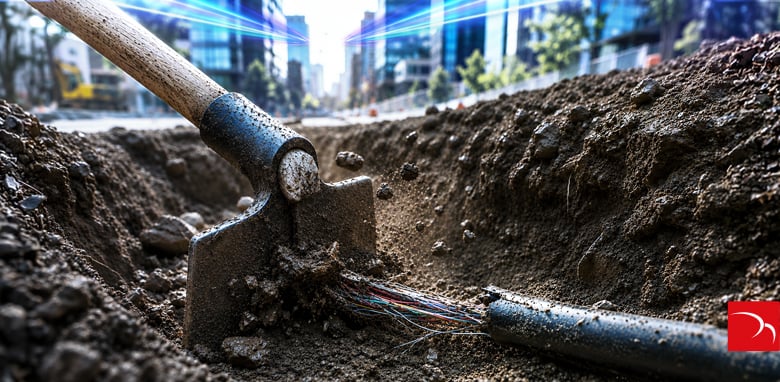
Network security is no longer only about cyber defense. As fiber cuts, copper theft, and infrastructure vandalism rise, mobile operators like “the big three” in the U.S. are taking note. They need physically diverse 5G backhaul paths that keep networks connected when primary routes are compromised.
And when AT&T, Verizon, T-Mobile, and cable operators form a united front, it’s time to pay attention. Their recent cooperation highlights a growing infrastructure challenge for communications service providers (CSPs): network theft and vandalism. Transport diversity—including reliable wireless backhaul connectivity—is what CSPs need to overcome this challenge and ensure network resilience.
Copper theft, fiber cuts, and other forms of physical disruption are now material risks to network continuity. As recently reported by Light Reading, the expansion of the Strategic Threat Response and Infrastructure Knowledge Exchange (STRIKE) initiative demonstrates how seriously the big three in North America view this threat. Indeed, network theft and vandalism incidents increased 59% year-over-year in 2025, affecting 11.8 million customers. And some industry observers consider these numbers to be conservative.
For years, network security has been viewed primarily as a cybersecurity discipline. And firewalls, encryption, zero-trust architectures, segmentation, and AI-driven threat detection remain essential. But operator networks are also facing more physical threats: damaged cables, cut routes, stolen infrastructure, construction accidents, severe weather, and localized attacks on critical network assets.
The lesson is clear: network security must now include physical transport resilience, where alternative paths ensure connectivity even when primary fiber routes are cut.
For mobile network operators (MNOs), that means designing 5G backhaul or transport networks not only for optimal capacity, latency, and cost-effectiveness, but also for route diversity, redundancy, and rapid restoration when physical infrastructure fails. This is where wireless backhaul becomes an essential part of resilient mobile network design.
Fiber cuts are now part of the security conversation
A network can be protected from cyber intrusion and still fail if a critical fiber route is cut.
That matters because communications networks support more than consumer mobile data. Emergency services, hospitals, public agencies, enterprises, fixed wireless access (FWA) users, and connected infrastructure all depend on continuous service. When physical transport routes fail, the impact can quickly move beyond a mere maintenance issue and become a serious service continuity problem.
For mobile operators, the risk is amplified because multiple sites may depend on the same physical path. A single damaged fiber route can affect macro cell backhaul connectivity, small-cell aggregation, enterprise connectivity, FWA capacity, and public safety traffic in the same area.
This is why the definition of network security is expanding. Cybersecurity protects against digital compromise. Transport resilience protects service continuity when infrastructure is damaged, stolen, cut, or disrupted.
Both are now part of the same operational conversation.
Resilience is not a fiber-versus-wireless debate
Fiber remains a critical foundation for modern communications infrastructure. It delivers high capacity, low latency, and long-term value across core, metro, aggregation, and many RAN transport routes.
But network resilience depends on more than single-link performance. It depends on what happens when that link fails.
The heart of the problem is here. If primary and secondary routes share the same trench, pole line, bridge crossing, manhole, cabinet, or aggregation point, the backhaul network may look redundant on paper while remaining exposed in practice. Physical diversity matters because many real-world failures are geographic. They affect the route, not just the equipment.
This is where wireless backhaul becomes strategically important.
Licensed microwave (MW) backhaul, E-band millimeter wave (mmW) backhaul, multiband backhaul, and other wireless transport links can create alternate paths that do not follow the same physical route as fiber. They can bypass vulnerable infrastructure, accelerate restoration, and connect sites where fiber is unavailable, delayed, cost-prohibitive, or difficult to protect.
5G wireless backhaul connects RAN sites (such as eNodeB and gNodeB base stations) to the mobile core, especially where fiber deployment is impractical or insufficient for rollout timelines.
The point is not to replace fiber everywhere. The point is to ensure connectivity when any single component, route, or access method fails.
Wireless backhaul – an alternate path when fixed routes fail
The most resilient networks are not built around a single transport technology. They are built with diversity.
For MNOs, wireless backhaul can strengthen resilience in several practical deployment scenarios:
Macro-cell continuity: Rural and suburban macro sites often require long-distance reach, high availability, and predictable restoration. Microwave backhaul can provide primary transport, backup transport, or route diversity where a second fiber path is uneconomical or unavailable.
Small-cell densification: Urban and suburban small cells are often constrained by street-level fiber, permitting, rooftops, poles, and rights of way. E-band and other mmW links can support high-capacity, short-range backhaul without waiting for new civil works.
Aggregation diversity: When several RAN sites depend on a shared fiber route, a wireless path can reduce the blast radius of a physical cut by providing an independent route into the aggregation layer.
Rapid restoration: After theft, vandalism, storms, or construction damage, wireless links can help restore priority sites before civil repairs are complete.
All this matters because 5G backhaul requirements continue to grow. At present, 5G networks typically require 3 Gbps in rural areas, 5 Gbps in suburban areas, 5–10 Gbps in urban areas, and more than 10 Gbps in dense urban areas. Wireless transport is no longer only a coverage tool or a fallback option. In many deployment scenarios, it is a primary resilience layer for modern 5G transport networks.
The What operators should ask when planning resilient 5G backhaul
As physical threats become more visible, MNO transport planning needs to move beyond the question of whether a site has enough capacity.
A resilient 5G backhaul plan should answer five key questions:
- Does the site have enough capacity for its actual deployment scenario?
Macro cells, small cells, indoor systems, FWA sites, and aggregation nodes do not have the same throughput profile. - Does the transport path meet latency and timing requirements?
D-RAN, C-RAN, and O-RAN architectures place different demands on backhaul, midhaul, and fronthaul. - Is the alternate path physically diverse?
Redundancy is weaker when two paths share the same trench, duct, pole line, cabinet, or aggregation point. - Can service be restored before civil repair is complete?
Restoration speed matters—especially when outages affect emergency services, enterprises, public infrastructure, or high-traffic mobile areas. - Does the design balance CAPEX, TCO, deployment speed, and risk exposure?
Fiber is the right answer in many places. Wireless is the right answer where diversity, speed, reach, or construction economics make fiber alone insufficient.
These questions make resilience measurable. They also help operators choose the right mix of fiber, licensed MW backhaul, E-band mmW backhaul, and other wireless transport options based on a specific scenario rather than general preference.
Security now includes continuity
As threats evolve, network security must evolve with them.
Protecting communications infrastructure today means addressing both digital and physical risk. While cybersecurity reduces the likelihood of digital compromise, transport resilience reduces the service impact when physical disruption occurs.
For MNOs, that makes wireless backhaul part of the resilience strategy for 5G networks. It gives operators an alternate path when fixed routes fail, supports faster restoration, and strengthens the backhaul network where route diversity is difficult to achieve with fiber alone.
The operators that succeed will be those that design networks capable not only of resisting attacks, but of continuing to operate when disruption happens.
Because customers do not measure security by how a network was attacked. They measure it by whether the network stayed connected.
Want to discover how a mix of fiber and wireless backhaul can keep your network connected and resilient?