


-1.jpg?width=780&height=408&name=BLOG_780x382%20(1)-1.jpg)
Networks aren’t running out of capacity. They’re running out of efficient ways to deliver it. From high-density 5G backhaul in urban environments to rural or mission-critical industrial use cases, networks are under constant pressure to deliver more: more bandwidth, more reliability, more scalability. This is especially true across mobile backhaul, where traffic growth continues to outpace traditional wireless backhaul scaling models. That pressure is only intensifying. Operators are not just asking, “How do we deliver more capacity?” They’re asking, “How do we deliver more capacity without driving costs through the roof?” Because in reality, the biggest challenge facing modern networks isn’t capacity itself. It’s the cost of delivering it. And that’s where a quiet but powerful shift is taking place, one that’s changing the economics of wireless networks at their core. Because when it comes to scaling efficiently, width matters.
What you’ll learn from this blog
Discover how wider channel bandwidth transforms backhaul economics by delivering higher capacity with fewer resources. Learn why moving from multi-channel to single wide-channel architectures simplifies network design, reduces costs, and accelerates deployment. You’ll also see how this approach enables more efficient scaling across 5G and wireless backhaul networks – and why the real challenge isn’t spectrum scarcity, but how efficiently it’s used.
- The Traditional Model of Adding Capacity: More of Everything
- Why One Channel Outperforms Two
- What Regulators Got Right
- How Do Wider Channels Lower Cost Per Bit?
- How Do Wider Channels Simplify Deployment and Operations?
- Scaling Without Tradeoffs
- How Do Wide Channels Fit into Multiband Backhaul?
- A Shift in Network Thinking
- Rethinking How We Deliver Capacity
- One Channel. Half the Complexity. Double the Impact.
The Traditional Model of Adding Capacity: More of Everything
Historically, increasing microwave backhaul capacity has followed a predictable pattern: add more. More radios. More channels. More hardware. When a single channel couldn’t meet demand, operators would stack multiple narrow channels, commonly using configurations like two 112 MHz carriers to achieve higher throughput. On paper, this works. In practice, it comes with tradeoffs.
Each additional channel introduces:
- Additional hardware and equipment costs
- Increased power consumption
- More complex installation and maintenance
- Greater spectrum coordination challenges
- Longer deployment timelines
What begins as a straightforward upgrade can quickly become a costly, resource-intensive burden, one that impacts everything from planning to operations. At scale, this approach becomes a barrier to growth, not an enabler.
As demand surges across 5G and mobile backhaul networks, along with broader wireless connectivity environments, operators need a more efficient way to scale capacity.
Why Is One 224 MHz Channel More Efficient than Two 112 MHz Channels?
The answer lies in not adding more radios but using what’s already available more efficiently.
That’s exactly the shift enabled by 224 MHz wide channel bandwidth for traditional microwave transmission. Instead of combining multiple narrow channels, operators can now use one broader transmission path to deliver equivalent or superior performance.
With a 224 MHz channel, it’s possible to deliver multi-gigabit capacity, up to 4 Gbps, in a single traditional microwave radio unit, without duplicate hardware or parallel transmission chains. But the real impact goes far beyond throughput. Because expanding channel width improves throughput while reducing operations overhead.
The difference becomes clear when you compare the two approaches side by side:
One Channel vs. Two
.jpg?width=780&height=395&name=TABLE_1%20(1).jpg)
Why One Channel Outperforms Two
Industry research consistently shows that capacity depends on both bandwidth and spectral efficiency. As defined in the European Telecommunications Standards Institute standard EN 302 217, the maximum transmission rate in a given bandwidth depends on system spectral efficiency.
Increasing channel bandwidth is one of the most direct ways to scale that capacity.
This is exactly what happens when moving from two 112 MHz channels to a single 224 MHz channel. A single wide channel eliminates guard bands, reduces interference, and avoids duplicate hardware.
What Regulators Got Right
For years, regulators faced a dilemma: enable more capacity while avoiding interference risks.
The concern was clear: would wider channels disrupt existing spectrum usage? Over time, regulatory evolution has reflected growing confidence in wider channels.
Standards bodies such as CEPT, ETSI, and ITU consistently highlight the role of wider channel bandwidth in enabling higher-capacity networks. As ETSI EN 302 217 notes, channel bandwidth is a key parameter determining the achievable capacity of fixed service systems. Similarly, CEPT emphasizes in ECC Report 319 that the use of wider channel bandwidths increases system capacity and supports the growing demand for high data rates. The ITU reinforces this principle, stating that increasing channel bandwidth is one of the principal means of achieving higher transmission capacity in fixed wireless systems as reflected in its ITU-R Recommendations.
At the same time, global institutions increasingly frame connectivity as essential infrastructure. The ITU describes broadband as essential infrastructure for the digital economy, while the World Bank notes that digital infrastructure is now as vital as electricity and transport systems. OECD similarly states that high-quality connectivity has become a fundamental enabler of economic and social activity.
Together, these perspectives reflect a broader realization: connectivity is no longer a luxury - it is a critical resource. And like any critical resource, it must be used efficiently.
To support rising backhaul demands, standards bodies expanded supported microwave channel bandwidths. Wider channels, up to 224 MHz, provide operators with a more efficient path to higher throughput and simpler network design.
Evolution of Microwave Channel Bandwidth for Higher-Capacity Backhaul
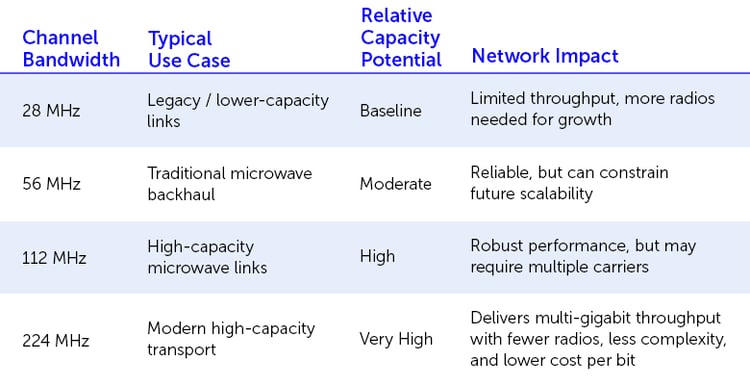
Adapted from: European Telecommunications Standards Institute EN 302 217-2 (2025) and International Telecommunication Union Recommendation F.1520 channel arrangements
How Do Wider Channels Lower Cost Per Bit?
For operators delivering high-capacity wireless connectivity, these efficiencies translate directly into faster, more cost-effective network expansion. This is where the economics shift. Because when you eliminate redundant components and simplify architecture, you don’t just improve performance, you reduce cost.
Same spectrum. Completely different outcome. Using a single 224 MHz channel instead of two narrow ones leads to:
- Reduced CAPEX (fewer radios, smaller footprint)
- Lower OPEX (less power, fewer failure points)
- Simplified spectrum usage
- Streamlined operations
Together, these fundamentally reshape cost per-bit - the metric that ultimately defines network economics.
How Do Wider Channels Simplify Deployment and Operations?
Beyond cost, fewer components also mean faster rollout, easier upgrades, and simpler maintenance—an important advantage in increasingly distributed networks. Network planning becomes more straightforward. RF design becomes cleaner. Operations become more efficient. In a world of increasingly distributed networks, this simplicity is a strategic advantage.
Depending on the deployment architecture, a single 224 MHz channel can materially reduce cost per bit by eliminating duplicate radio equipment and simplifying installation, power, licensing, maintenance, and operations.
Simple cost model example
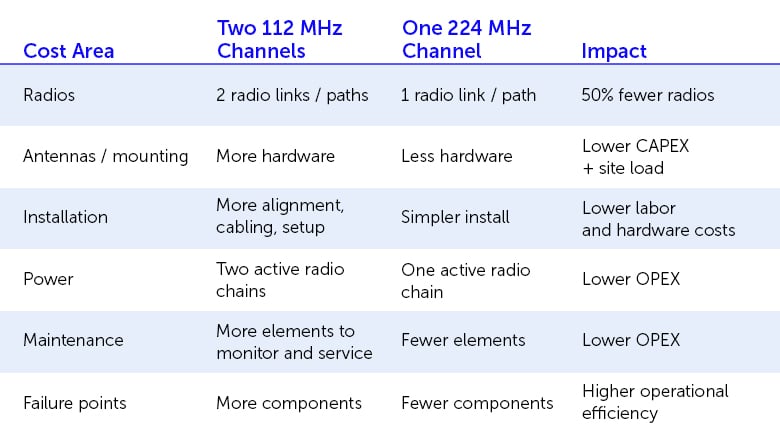
By replacing two narrower channels with a single 224 MHz channel, operators can potentially eliminate an entire radio path, reducing hardware, installation, power, maintenance, and management overhead. That is where the economics shift: capacity increases, but complexity does not.
Scaling Without Tradeoffs
Across 5G backhaul, mobile backhaul, and next-generation wireless backhaul architectures, these demands continue to grow. Today’s networks must support:
- Urban densification
- Private LTE/5G
- Industrial and mission-critical applications
- Rural expansion
Each of these demands high capacity, but also efficiency.
224 MHz enables networks to grow efficiently, delivering multi-gigabit performance without increasing operational burden.
This is scalability without compromise - without increasing complexity.
How Do Wide Channels Fit into Multiband Backhaul?
This is where multiband architectures come into play, combining wider channel microwave and E-band to unlock higher capacities without increasing complexity. The impact of 224 MHz doesn’t stop at a single link. It creates a stronger foundation for scaling capacity across the network, without adding unnecessary layers or overhead.
As traffic demands grow, Ceragon supports this approach, enabling operators to expand throughput across microwave, multiband, and wireless backhaul networks in clear, efficient steps, using the right architecture at each stage. Ceragon supports this model, helping operators scale capacity while maintaining a lean, efficient network design.
Ceragon Capacity Scaling Path
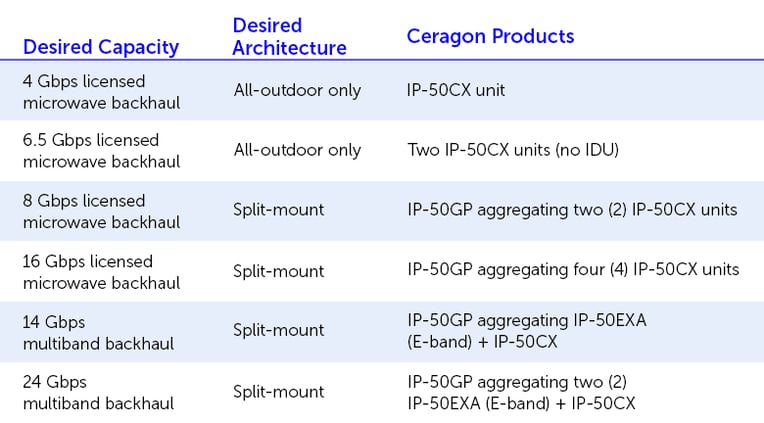
Instead of stacking channels and duplicating infrastructure, operators can scale through cleaner building blocks that reduce hardware, simplify operations, and lower total cost over time.
Every additional component adds time:
- Planning
- Deployment
- Configuration
- Maintenance
- Smarter spectrum use
- Leaner infrastructure
- Scalable growth
By reducing components, 224 MHz accelerates everything.
Faster deployment. Faster service activation. Faster revenue generation.
In competitive markets, that speed matters.
A Shift in Network Thinking
For years, the industry focused on what was technically possible. Now, the focus is shifting to what is economically sustainable. Wider channels represent this shift across modern wireless backhaul and connectivity networks:
This isn’t just a technical evolution. It’s a strategic one.
Rethinking How We Deliver Capacity
The old model: adding hardware, stacking channels, increasing complexity, is reaching its limits. The new model is simpler: Use wider channels. Reduce overhead. Maximize efficiency = Deliver more with less.
One Channel. Half the Complexity. Double the Impact.
224 MHz isn’t just the widest channel available. It’s a fundamentally better way to scale. A way to increase capacity without increasing cost. To simplify networks while enhancing performance. To accelerate growth without adding friction. In a world where every bit, and every dollar, counts, that’s not just an advantage. It’s a transformation.
Ceragon’s wide-channel microwave and multiband wireless backhaul portfolio brings this model to life, delivering higher throughput, lower cost, and faster deployment through a simpler, more efficient architecture. Because in a world where every bit and every dollar count, efficiency isn’t an advantage. It’s the architecture.
Interested in reading more about our All-Outdoor Solutions supporting wide channels? Download our Solution Brief.

FAQs
1. What are the spectral efficiency gains when using a single wide channel vs. multiple narrow channels?
A single wide channel eliminates guard bands and reduces inter-carrier interference, improving overall spectral efficiency. In practice, this means more usable throughput from the same spectrum allocation.
2. Are there specific regulatory or spectrum constraints when deploying 224 MHz channels?
Yes, deployment depends on regional spectrum regulations and channel availability. However, standards bodies like ETSI and ITU increasingly support wider channels, and many regulators now allow 224 MHz in suitable bands.
3. How does a wide-channel approach affect RF planning and interference management?
RF planning is typically simplified. With wider channels, there’s no need to manage cross-carrier interference or spacing between channels. This results in cleaner frequency planning and fewer coordination challenges.
4. What are the hardware and architecture implications of moving to wider channels?
Wider channels reduce the need for multiple radios and aggregation layers. In many cases, a single radio can replace dual-carrier setups, simplifying the overall architecture and reducing points of failure.
5. How does this approach integrate with multiband deployments (e.g., microwave + E-band)?
Wider microwave channels provide a strong base layer that can be aggregated with E-band links for higher capacities. This enables scalable, stepwise growth without requiring major architectural changes.
TAKEAWAYS
- Wider channels improve spectral efficiency and reduce RF complexity
- Single-carrier designs simplify planning, deployment, and troubleshooting
- Link performance remains strong with proper design and adaptive technologies
- Fewer radios mean lower failure risk and easier maintenance
- Multiband architectures extend capacity further without added complexity
- Efficient spectrum use is key to scaling modern backhaul networks




