
Industrial environments are no longer confined to a single site. They span substations, pipelines, remote facilities, and mobile assets, often operating in harsh and unpredictable conditions. As these environments expand, one challenge becomes critical: maintaining a consistent, shared view across sites, systems, and infrastructure. Most organizations still rely on multiple tools to monitor networks, devices, and operational systems. These tools operate in isolation, creating fragmented views of what’s happening across the environment.
The result?
Operations and IT teams are forced into reactive modes; responding only after issues impact uptime, safety, or service delivery. The shift now underway across utilities, oil & gas, mining, and critical systems is clear: from fragmented monitoring to unified, real-time operational intelligence – bringing together network, OT, IIoT, and edge data into a single view.
What you’ll learn from this blog
How bringing together network, OT, IIoT, and edge data into a unified platform enables a single, shared view across sites and systems, supporting more proactive and coordinated operations, faster decision-making, and improved operational resilience
- Why a Shared View Matters - Building Smarter, More Resilient
- A New Approach to Monitoring and Integration – What modern platforms provide
- The Role of Network Monitoring – What remains essential
- Where Fragmentation Creates Gaps – Understanding the challenge
- Bridging Network and Operations – Bringing systems together
- Where Ceragon IMS Fits – Bringing it all together
- From Monitoring to Operational Intelligence – From reactive to proactive
- Turning a Shared View into Operational Advantage – Driving outcomes
- See How It Works in Practice – Webinar demo
Why Shared View Matters
In distributed industrial environments, visibility is no longer just about seeing individual systems—it’s about understanding how everything works together.
Without a shared view:
-
- Teams rely on partial, disconnected data
- Issues take longer to understand and resolve
- Coordination between operations and IT breaks down
A unified view changes this dynamic, giving teams a common operating picture across sites and systems.
A New Approach to Monitoring and Integration
Modern environments require more than isolated monitoring tools. They require a way to bring together data across network infrastructure, OT systems, IIoT devices, and edge environments into a unified, topology-aware platform. This approach enables organizations to:
- Monitor OT assets, IIoT devices, edge systems, and network infrastructure in one place
- Work across multi-vendor, multi-protocol environments
- Correlate events across network, OT, and edge domains without manual analysis
- Create a single, shared, cross-domain operational view
Platforms such as Ceragon IMS are designed to deliver this unified, cross-domain visibility, acting as a single pane of glass across network, OT, and edge environments, while preserving the depth and context of each domain
The Role of Network Monitoring
Network monitoring remains essential. It provides visibility into:
- Transport and communication links
- Network performance and availability
- Device status, alarms, and topology
These capabilities are foundational for ensuring reliable data flow. But on their own, they only tell part of the story. In complex environments, understanding what is happening operationally requires combining network data with OT systems, field assets, and edge environments.
Where Fragmentation Creates Gaps
Across industries, the same challenge appears in different forms:
UTILITES
Distributed grid infrastructure requires visibility across both communications and operational systems
OIL & GAS
Remote pipelines and facilities depend on coordinated operations across multiple systems
MINING
Mobile assets and harsh environments require awareness of both network performance and operational conditions. In each case, fragmented tools create:
- Blind spots between domains
- Slower fault detection and resolution
- Increased operational complexity
- Limited coordination between teams
Bridging Network and Operations – Bringing systems together
Addressing fragmentation isn’t about replacing systems, it’s about connecting them.
By bringing together data across network, OT, IIoT, and edge environments into a unified cross-domain platform, organizations can:
- Monitor infrastructure and assets from one interface
- Correlate events across domains
- Align operations and IT teams around shared data
- Reduce reliance on siloed tools
- Provide topology-aware visibility across sites, systems, and network layers
This creates a unified layer of visibility across the entire operational ecosystem.
Where Ceragon IMS Fits – Bringing it all together
Ceragon IMS delivers a unified, topology-aware layer of operational visibility, serving as a single pane of glass across network infrastructure, OT systems, IIoT devices, and field assets.
By correlating events across domains and presenting them in real time, IMS enables operations and IT teams to detect issues faster, understand their impact, and respond with greater confidence.
Designed for distributed, mission-critical environments, IMS connects existing systems without replacing them, reducing disruption while unifying visibility across environments, creating a shared operational picture across sites, teams, and technologies.
From Monitoring to Operational Intelligence
When data is unified and contextualized, monitoring evolves from isolated alerts into correlated, context-aware insight across the entire operational environment.
Organizations gain the ability to:
- Understand issues across domains—not just within one system
- Identify patterns using historical trends, event correlation, and topology context
- Respond faster with more informed decisions
- Support proactive, coordinated operations across sites
This is the shift from monitoring to operational intelligence; not by adding complexity, but by simplifying how information is brought together and used.
Turning a Shared View into Operational Advantage
A single, shared view—effectively a single pane of glass across the operational environment—transforms how teams operate:
- Teams work from the same real-time information
- Faster fault isolation reduces downtime
- Cross-domain visibility improves coordination
- Historical insight supports better planning
- Centralized visibility simplifies complex environments
THE RESULT:
- Reduced operational risk
- More consistent performance across sites
- Improved efficiency in day-to-day operations
Visibility is no longer just about observing systems, it becomes the foundation for resilient, scalable operations.
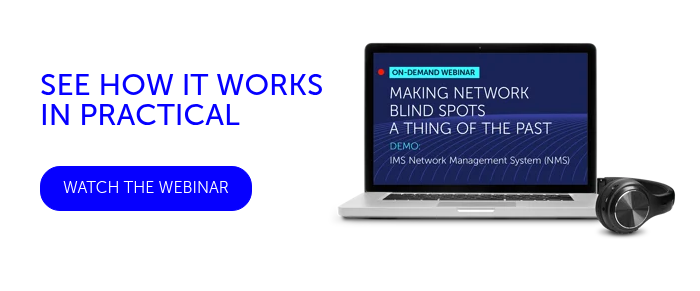
For a practical walkthrough of how unified monitoring and data integration work in real environments, including real-time topology mapping, cross-domain alarm correlation, and unified visibility across network and operational environments, explore the on-demand session:
FAQs
1. How is Ceragon IMS different from traditional network monitoring approaches?
Traditional monitoring tools focus on network performance, device status, and alarms. Ceragon IMS builds on these capabilities by correlating network data with OT systems, field assets, and edge environments, providing cross-domain visibility and operational context.
2. Does this require replacing existing systems?
No. It connects and builds on existing monitoring and operational systems, enabling organizations to unify visibility without disrupting existing infrastructure or workflows.
3. Can this work across multi-vendor and multi-technology environments?
Yes. Unified monitoring platforms are designed to operate across diverse environments, bringing together data from different vendors, protocols, and systems into a single, shared, cross-domain operational view.
4. What does “operational intelligence” actually mean in practice?
It means moving beyond isolated alerts to understanding how events relate across systems, using event correlation, historical trends, and topology context to support faster, more informed, and more coordinated decision-making.
5. Do teams really work from a single interface?
Yes. By acting as a single pane of glass across network, OT, and edge environments, Ceragon IMS enables teams to monitor, correlate, and understand events from one interface, reducing the need to switch between tools while preserving the context of each domain.
TAKEAWAYS
-
A shared view is critical - Unified visibility enables better coordination across systems and teams
-
Fragmentation increases complexity - Siloed tools create blind spots and slow response
-
Network monitoring remains foundational - But must be combined with broader operational data
-
Unified platforms connect systems - Bringing together OT, IIoT, edge, and network data
-
Operations become proactive - Teams can act earlier and more effectively
-
Distributed industries benefit most - Utilities, oil & gas, and mining gain improved coordination and resilience




